
In many African homes, the conversation about your future starts and ends with one sentence: "You will go to school, you will get a degree, and you will get a good job." That is the plan. That has always been the plan. Nobody asked questions. You just nodded, picked a course and got on with it.
But something is shifting.
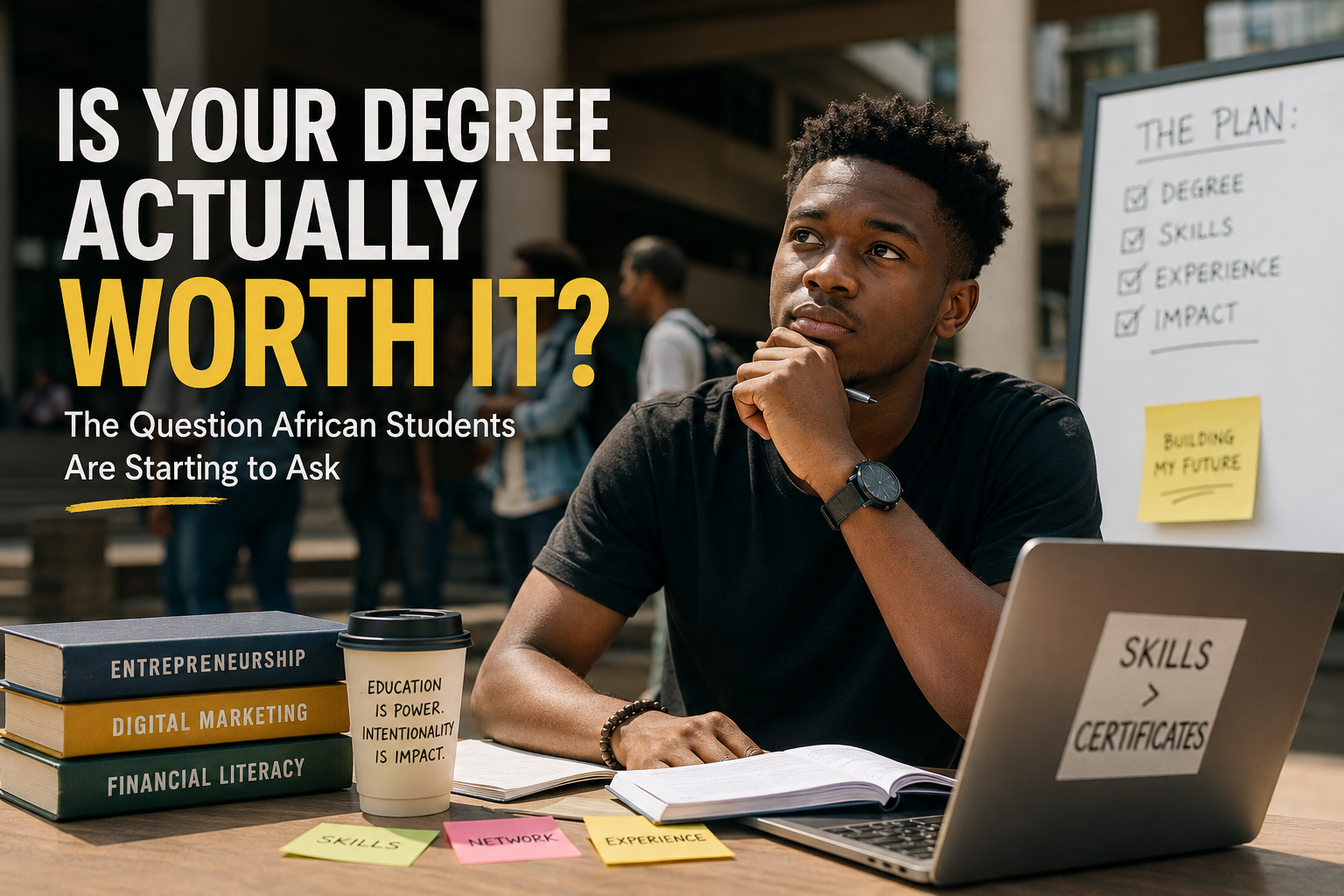
Students are starting to ask real questions. Uncomfortable ones. Questions like: Is this degree actually going to do anything for me? Am I paying for an education or just paying for a certificate that says I sat in a classroom for four years?
And honestly, it is about time we asked.
More than ever, African students are demanding value from their education – not just a stamped certificate. This shift could change everything.
The Promise That Was Made to Us
Here is what we were told, in schools, at home, at every family gathering where an older relative decided it was time to give advice:
"Get a degree. That is your ticket."
And for a long time, it was. A generation ago, having a university degree in The Gambia, or Nigeria, or Ghana, or Kenya actually meant something different. The pool of graduates was smaller. The jobs were more clearly defined. You studied engineering, you became an engineer. You studied law, you became a lawyer. The path was straight, and the degree was the key that unlocked it.
But the world changed. The number of graduates grew. The jobs did not grow at the same speed. And suddenly, the degree stopped being a key and started being something else entirely.
You get your degree. You join the queue. You wait.
Sound familiar?
What Is Actually Happening Out Here
I want to be clear about something. I am not here to tell you that education is useless. Education is one of the most powerful things a human being can experience. The ability to read critically, to think through problems, to understand the world you live in, that is genuinely priceless.
But we need to separate education from a degree. Because they are not always the same thing.
A degree is a document. Education is what happens in your mind. And right now, a lot of students are getting the document without getting nearly enough of the other thing.
Here is what the numbers tell us. Youth unemployment in sub‑Saharan Africa sits somewhere between 20% and 60% depending on the country and who is counting. Many of those unemployed young people have certificates. They have results slips. They walked across a stage and shook someone's hand. But they cannot find work.
And at the same time, some of the most employed, most entrepreneurial, most financially stable young people around them never finished university. Or never went at all.
That contradiction is what is making people ask the question.
“The degree has not become worthless. But it has become insufficient on its own.”
The Degree Is Not the Problem. The System Is.
Let me be careful here, because it is easy to misread what I am saying.
The problem is not that you went to university. The problem is what happens, or does not happen, inside many of our universities.
Think about it honestly. How many of your lecturers are teaching from slides that were last updated in 2009? How many of your courses are preparing you for industries that barely exist in Africa yet, while completely ignoring the industries that are actually growing around you? How many times have you sat in a lecture and thought, "I could have learned this from a YouTube video in forty‑five minutes"?
This is not a small thing. This is a structural failure.
Universities across Africa were largely built on models designed in Europe and America, for different economies, different labor markets, different times. And too many of them have not evolved fast enough to keep up with the world their students are about to walk into.
The result is graduates who can write a dissertation but cannot write a professional email. Graduates who can solve a calculus problem but cannot manage a basic budget. Graduates who know the theory of everything and the practice of almost nothing.
Employers across Africa consistently report that new graduates lack practical workplace skills – not because students are incapable, but because the curriculum hasn't caught up.
What the New Generation Is Figuring Out
Here is where it gets interesting.
Students, especially African students, are not sitting quietly with this problem. They are adapting. They are building. They are learning on the side. They are doing internships, yes, but they are also doing online courses, getting certificates, taking on freelance work, starting side businesses and community projects, sometimes while still in school full time.
This is not a distraction. This is intelligence.
The student who is studying accounting by day and building a small content creation business by night is not losing focus. They are doing what the market is teaching them to do: do not put everything in one basket, especially when you are not sure the basket is strong enough.
Across the continent, young people are selling things online, building apps, consulting, designing, translating, tutoring, farming with technology, running small logistics operations. Many of them never needed a degree to start any of it. They needed skills, a phone, and a problem worth solving.
The question is not whether this is good or bad. The question is what this tells us about what the system is and is not providing.
So Should You Drop Out?
No. And I want to be very direct about that.
Dropping out is a serious decision with serious consequences, especially in African societies where the social and professional cost of not having a degree is still very real. Employers still look for it. Families still care. And in sectors like medicine, law and engineering, there is no shortcut. You need the qualification.
What I am saying is more layered than simply stay or leave. What I am saying is this: be intentional about why you are there and what you are getting out of it.
A degree pursued with intention, where you are actively building skills, building relationships, doing internships, asking hard questions, challenging your lecturers, working on projects that actually matter, that degree still has enormous value. Not just because of what it says on paper, but because of who you become in the process.
A degree done on autopilot, where you attend lectures, cram for exams, pass and repeat, that is where the risk lives. You can finish four years with a certificate and very little real capability to show for it.
The degree is a container. What you put inside it is entirely up to you.
The Conversation We Need to Have
The question "Is my degree worth it?" is not a dangerous question. It is an honest one. And African students asking it out loud, in dorm rooms, on social media, in group chats, that is not a sign of a generation giving up on education. It is a sign of a generation that has started thinking critically about their own future.
That, by the way, is exactly what education is supposed to produce.
What needs to change is not whether students go to university. What needs to change is what universities offer them when they get there. More practical skills. More engagement with local industries. More entrepreneurship built into the curriculum. More mentorship from people who are actually working in the fields students are studying. More honesty from institutions about what the job market actually looks like.
And from students, more agency. More curiosity. More of a refusal to be passive recipients of an education that does not serve you.
“Your degree can be worth it. But only if you decide to make it worth it. Nobody else is going to do that for you.”
A Final Thought
There is a generation of parents across Africa who sacrificed enormously to send their children to university. Time, money, sleep, comfort. That sacrifice was real. It was made out of love and out of genuine belief that education was the path to a better life.
They were not wrong. They were working with the best information they had.
But now we have new information. And what we do with it matters.
The degree has not become worthless. But it has become insufficient on its own. The students who will thrive are the ones who understand that the certificate is just the beginning and not the destination. The ones who graduate with skills, not just credits. The ones who, four years into their studies, are already building something, already practicing something, already becoming someone the world will find genuinely useful.
Your degree can be worth it. But only if you decide to make it worth it.
Nobody else is going to do that for you.
What do you think? Is the degree still worth it where you are? Write to us at Life of a Student. We want to hear your story.