
If you really want to understand a person, don’t ask them about their dreams, their goals, or their five-year plan. Put them in a group project.
That’s where the truth comes out.
Not the Instagram truth. Not the polished LinkedIn version where everyone is “passionate about collaboration.” I’m talking about the raw, unfiltered reality. The kind where one person disappears completely, one person becomes the self-appointed CEO, and one poor soul ends up doing everything while quietly questioning their life choices.
Group projects are not just academic exercises. They are psychological experiments. They expose everything we’ve been taught about work, responsibility, leadership, and survival. And if you look closely, they reveal something uncomfortable.
We were never really taught how to work together.
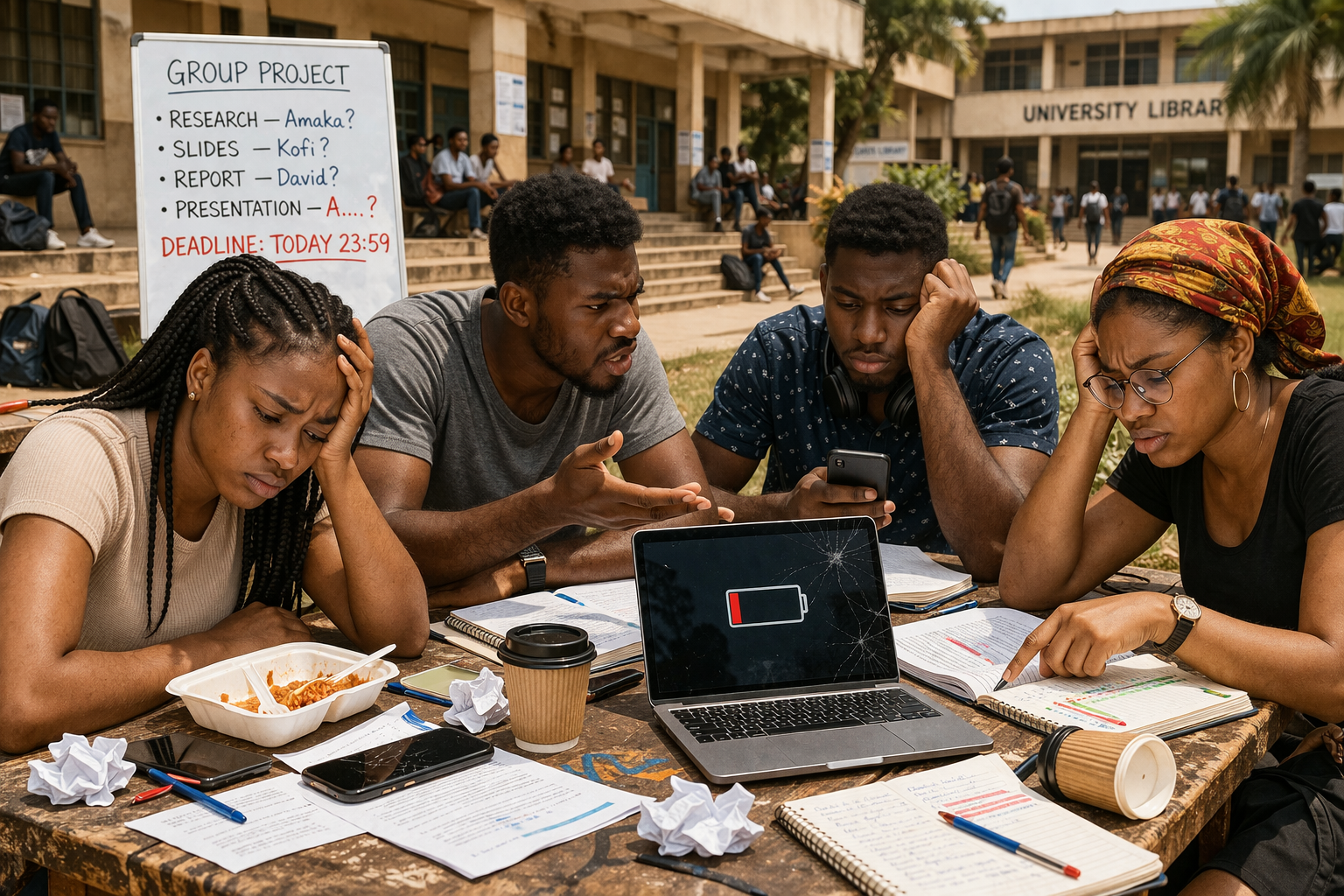
The Illusion of Collaboration
From a distance, group projects look like a good idea. The logic is simple. Put people together, give them a task, and they will learn teamwork. It sounds beautiful. Almost poetic.
But here’s the problem. Putting people in a group is not the same as teaching them how to collaborate. It’s like throwing five people into a kitchen and saying, “Cook.” No recipe. No roles. No understanding of who knows what. Just vibes. And then we act surprised when the food tastes like confusion.
Most students enter group projects with zero training in collaboration. Nobody ever taught them how to divide work effectively. Nobody explained how to manage conflict. Nobody showed them how to communicate expectations clearly. Instead, we assume they will figure it out. And what happens? They don’t. They improvise.
The Rise of the “Silent Passenger”
Every group project has one. The silent passenger. This is the person who somehow exists in the group without actually participating. They attend meetings but say nothing. They read messages but don’t reply. They promise to contribute “later,” a magical time that never arrives.
At first, people get frustrated. They think the silent passenger is lazy. But let’s challenge that assumption. What if they are not lazy? What if they were never taught how to contribute?
Think about it. Most education systems reward individual performance. You sit alone. You study alone. You take exams alone. You are told your success is your responsibility. Then suddenly, one day, you are placed in a group and expected to perform collectively. That’s not a small adjustment. That’s a complete mindset shift.
For some students, speaking up feels risky. What if their idea is wrong? What if they are judged? What if they slow the group down? So they choose silence. Not because they don’t care, but because they don’t feel safe enough to participate. And instead of addressing that, we label them. Lazy. Useless. Dead weight. But the real problem is deeper: we never taught them how to belong in a team.
The silent passenger is often not lazy – they are untrained. Collaboration is a skill, and most students have never been taught it.
The Overachiever Trap
On the opposite side, you have the overachiever. This person is the hero and the victim at the same time. They take control early. They organize everything. They assign tasks. They follow up. They redo other people’s work “just to be safe.”
At first, everyone is grateful. Then something strange happens. The group stops trying. Why? Because the overachiever has unintentionally trained them not to. When one person takes responsibility for everything, others naturally step back. Not always out of laziness, but out of logic: if someone is already doing it, why interfere?
And so the overachiever becomes trapped in their own competence. They complain about carrying the group, but they also don’t let go. They don’t trust others to deliver. They don’t create space for mistakes. They don’t allow the team to grow. This is conditioning. We’ve been taught that success is individual, that your grade is your identity, that failure is unacceptable. So when group work threatens that, the overachiever takes control – not because they love leadership, but because they fear losing control.
The Fake Leader Problem
Then there’s the leader. Or at least, the person who thinks they are the leader. They speak the most. They make decisions quickly. They use phrases like “Let’s be efficient” and “We don’t have time.” They look confident. But confidence is not leadership.
Real leadership is not about control. It’s about coordination. Understanding people’s strengths, creating clarity, and making sure everyone is moving in the same direction. Most student leaders don’t do that. They dominate. Why? Because that’s what they’ve seen. In many classrooms, authority is top‑down. The teacher speaks, students listen. Decisions are made by one person. So when students are put in leadership roles, they copy that model. They don’t facilitate. They command. And the group suffers.
The Communication Breakdown
If you trace most group project failures back to their root, you’ll find one thing: communication. Or more accurately, the lack of it. Messages are vague. Deadlines are unclear. Expectations are assumed, not stated. Someone says, “I’ll handle the research.” What does that mean? How much research? What format? By when? Nobody asks.
And then, a few days before submission, chaos begins. Files are incomplete. Work doesn’t match. People start blaming each other. The problem didn’t start at the deadline. It started at the beginning, when nobody defined anything. Communication is a skill – and like any skill, it needs to be taught.
The Grade System Problem
Let’s talk about the elephant in the room: grades. In most group projects, everyone gets the same grade. Sounds fair, right? Wrong. This system creates tension from the start. High‑performing students feel exploited. Lower‑performing students feel pressured or disconnected. Instead of encouraging teamwork, the grading system creates competition within the group. People start thinking, “How do I protect my grade?” instead of “How do we succeed together?”
That’s a fundamental misalignment. If the system rewards individuals but expects collaboration, you create conflict. And then we blame the students. But the system set them up.
“The shared grade does not reflect the real world. In the real world, managers have visibility into who is doing what. There are performance reviews. The real world does not hand everyone the same outcome regardless of input.”
The Fear of Conflict
Here’s another silent killer: avoidance. Most students would rather suffer in silence than confront a teammate. They won’t say, “You’re not contributing.” They won’t say, “This work isn’t good enough.” They won’t say, “We need to change direction.” Why? Because they were never taught how to handle conflict. In many cultures and classrooms, disagreement is seen as disrespect. Speaking up feels like creating problems. So people stay quiet, and the problem grows. By the time someone finally speaks, emotions are high and trust is low. Conflict is not the enemy – unmanaged conflict is.
The Myth of “Natural Teamwork”
There’s this idea that teamwork is natural. That humans are social, so they should automatically work well together. That’s a myth. Working together effectively requires clarity, trust, accountability, and communication. None of these are automatic. They are learned behaviors. But in most education systems, we don’t teach them directly. We test individuals. We reward independence. We celebrate personal achievement. Then we suddenly expect teamwork. It’s like training someone to run solo races for years, then putting them in a relay and expecting perfect coordination. It doesn’t work like that.
They are exposing the gap between what we teach and what the real world requires. In the real world, almost everything is collaborative. But we train students as individuals. Group projects are not broken – they are honest. They show us that the system is incomplete.
So What Should Be Different?
Let’s not just complain. Let’s fix the thinking. If group projects are going to prepare students for real work, the way we approach them needs to change.
- Collaboration needs to be taught, not assumed. Students should learn how to assign roles, set expectations, and manage timelines.
- Communication should be structured. Define clear deliverables: who is doing what, by when, in what format. Clarity reduces conflict.
- Accountability needs to be both individual and collective. Not everyone should get the same grade by default. Contribution should matter.
- Leadership should be guided. Teach what good leadership looks like – coordination, not control.
- Conflict should be normalised. Disagreement is not failure; it’s part of collaboration. The goal is to manage it well.
The Real Lesson Most Students Miss
The real value of group projects is not the project. It’s the process. The frustration you feel? That’s training. The miscommunication? That’s a lesson. The moment you realise someone thinks completely differently from you? That’s growth. But only if you reflect on it.
Most students just want to survive the project – submit the work, get the grade, move on. They miss the deeper question: How do I work with people who are not like me? Because that question doesn’t disappear after university. It follows you into every job, every business, every partnership.
The Brutal Truth
Most people are not bad teammates. They are untrained teammates. They were never shown how to collaborate, so they default to what they know: silence, control, avoidance, overwork. Group projects don’t create these behaviours – they reveal them. And they also give you a choice. You can keep repeating the same patterns, or you can learn. Learn how to communicate clearly. How to set boundaries. How to lead without dominating. How to contribute without disappearing.
That’s the real education. Not the slides, not the report, not the presentation. But the ability to work with other human beings without losing your mind.
Final Thought
Next time you’re in a group project, don’t just focus on finishing the task. Study the dynamics. Who speaks? Who stays silent? Who takes control? Who avoids responsibility? And then ask yourself a harder question: Which one am I? Because the problem is not just the system. It’s also how you show up inside it.
Fix that, and suddenly group projects stop being a nightmare. They become practice. And if you get that right, you’re not just preparing for a grade – you’re preparing for reality.