
Most students take notes like they’re photocopy machines. Everything goes in—nothing actually sticks. The lecturer talks, they write. Slide changes, they write. A definition appears, they copy it word for word. By the end of the lecture, their notebook is full—but their understanding is empty.
Then exam season comes, and they flip through pages of notes that feel strangely unfamiliar. It’s like someone else wrote them.
That’s the problem.
Effective note-taking isn’t about recording everything. It’s about capturing what matters in a way your brain can actually use later. If your notes don’t help you think, recall, and revise quickly, then they’re just decoration.
Let’s fix that.
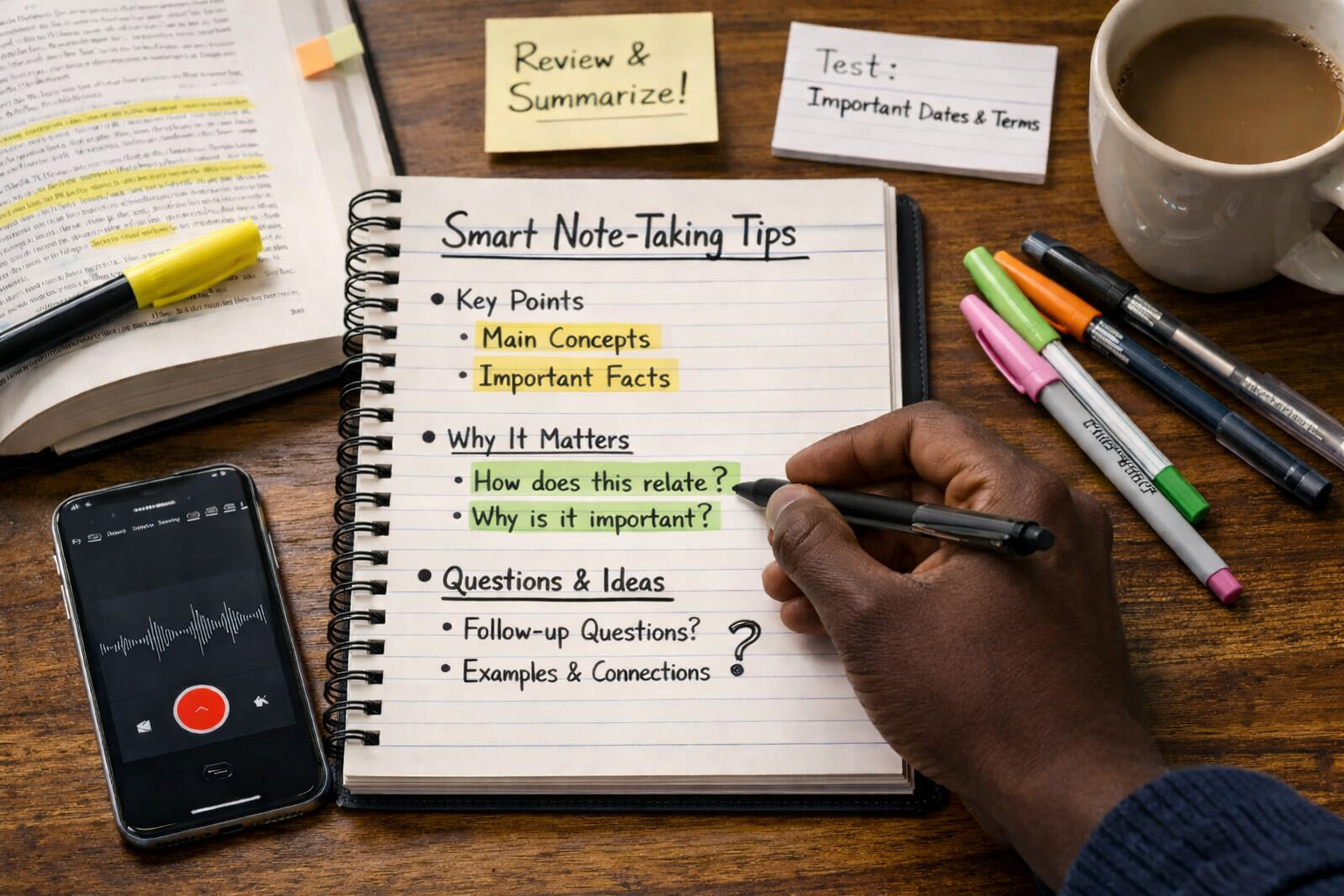
Notes are not a transcript. They are a tool for thinking, a bridge between learning and remembering, and a shortcut for future revision. If your notes don’t help you answer questions without looking, they’ve failed.
The Cornell Method (Best for Most Students)
If you want one system that works across almost every subject, use the Cornell Method. It’s simple, structured, and brutally effective – if you actually use it properly.
Step 1: Divide Your Page
Split your page into three sections:
- Right side (largest): Main notes
- Left side (narrow column): Questions / cues
- Bottom section: Summary
Step 2: During the Lecture (Right Column)
Don’t try to write everything. Capture key ideas, not full sentences. Use bullet points, abbreviations, and symbols. Focus on concepts, not wording. Think: “If I had to explain this later, what would I need?”
Step 3: After the Lecture (Left Column)
Go back and write questions based on your notes, keywords, and prompts that test your understanding. Example: “What are the 3 causes of inflation?” “Define opportunity cost.” Now your notes are interactive, not passive.
Step 4: Write a Summary
At the bottom, write a 1–2 sentence summary of the entire lecture. This forces you to condense information, identify the main idea, and check if you actually understood anything.
Step 5: Use It for Revision
Cover the right side. Look at the left questions. Try to answer from memory. If you can’t answer, you don’t know it. No illusions.
If you don’t review your notes within 24 hours, you’ve already lost most of it. Spend just 10–15 minutes after every lecture re‑reading, filling gaps, adding questions, and simplifying messy sections. This small habit separates struggling students from those who cruise through exams.
Mind Maps (For People Who Hate Linear Notes)
Not everyone thinks in straight lines. Some people need to see connections, not lists. That’s where mind maps come in.
- Start with the main topic in the center
- Branch out into subtopics
- Add smaller branches for details
- Use colors, arrows, and simple drawings
Subjects where this works best: History, Biology, Business, Sociology – anything about relationships, causes, and structures.
Your brain is wired to remember images, patterns, and connections – not paragraphs. But if your mind map is messy and unclear, it’s useless. Rule: if someone else can’t understand your mind map in 30 seconds, you did it wrong.
Digital vs. Paper: Stop Debating, Start Thinking
Both have strengths. Both have weaknesses. Research consistently shows that handwriting notes forces you to process information, leading to better understanding. But typing gives you speed, searchability, and easy sharing.
The smart strategy: combine them. During lecture, handwrite. After lecture (within 24 hours), type and clean up. That second step – rewriting – reorganizes ideas, simplifies, and reinforces memory. That’s where learning actually happens.
Stop Writing Like a Robot
Most students write notes as full sentences and long paragraphs. This is inefficient. Instead, use arrows →, abbreviations, symbols (*, ?, !), and break ideas into chunks.
Example – Bad: “Photosynthesis is the process by which green plants use sunlight to synthesize nutrients from carbon dioxide and water.”
Better: “Photosynthesis = plants use sunlight; CO₂ + H₂O → glucose + O₂; happens in chloroplasts.” Same idea, less noise, more clarity.
When exam week comes, your notes should save you time, trigger memory instantly, and help you test yourself. If instead you feel overwhelmed, confused, or lost in your own writing, your note system failed you.
The Real Secret: Active Recall
Taking notes is step one. Reviewing them is step two. Testing yourself is step three. Most students stop at step one. Big mistake.
What you should be doing: Cover your notes, ask yourself questions, try to recall from memory, check your answers. This is called active recall. It’s uncomfortable, effortful – and it works.
One Final Reality Check
You don’t have a note-taking problem. You have a thinking problem. If you copy without understanding, never review, and never test yourself, no method will save you. But if you engage during lectures, structure your notes, review consistently, and test your memory, even average notes will become powerful.
The Bottom Line
Good notes are not about writing more. They’re about writing smarter. Use structure (Cornell). Use visuals when needed (mind maps). Combine paper and digital. Review within 24 hours. Test yourself constantly. Do this, and your notes will stop being a pile of information – and start becoming a tool for winning exams.